Contrapposto
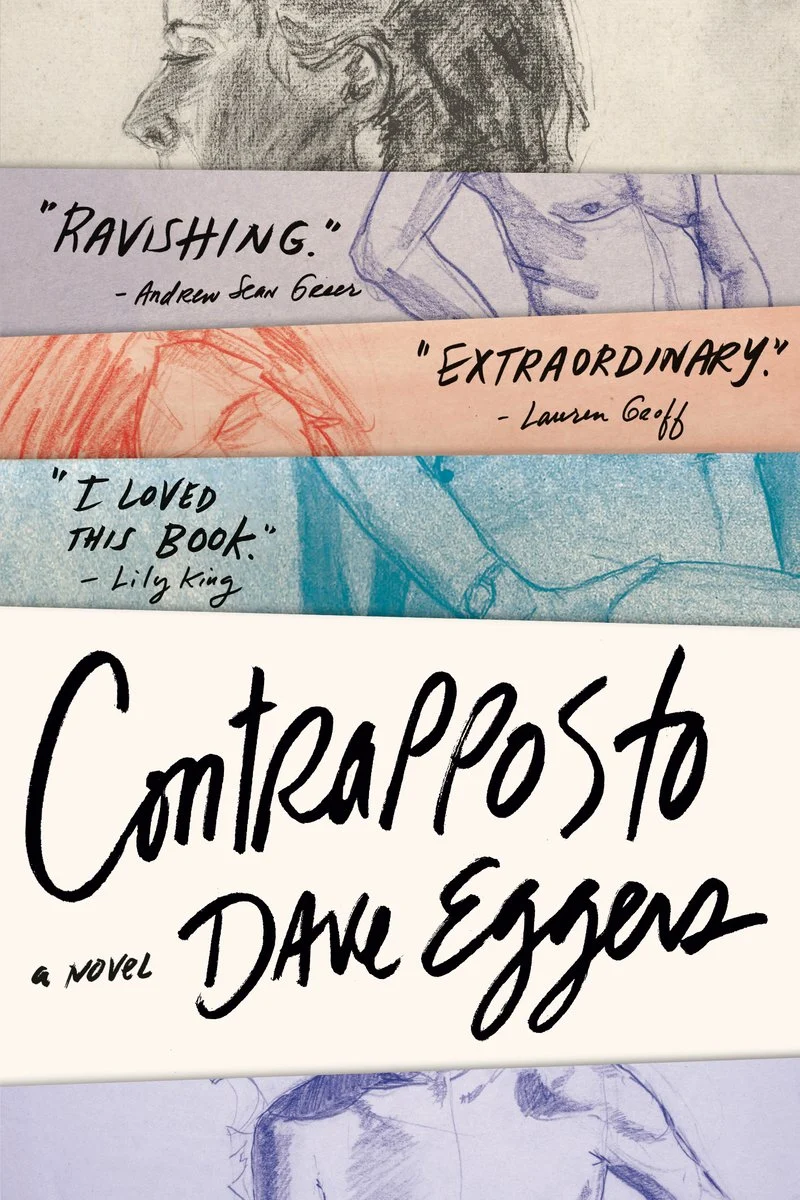
Book Details
- Title: Contrapposto
- Author: Dave Eggers
- Get a copy: Bookshop
Publisher Summary
Cricket Dib, born on the American prairie, has no particular prospects or ambitions until, in grade school, he realizes he can draw. He soon meets a girl, Olympia Argyros, one year older, who is captivating and brilliant and far more worldly. Recognizing his talent, she convinces him to deface, with profound vulgarity, a popular playground. Under her direction, he does it willingly, already in love, and thus begins a sixty-five-year entwining between Cricket and Olympia, encompassing friendship, working partnership and love affair. Together they go to art school—an experience of dubious value—and then navigate the art world for the next fifty years, together and apart.
Review
I enjoyed this book way more than I thought I would. The publisher's summary pushes the relationship between Cricket and Olympia; while this is the core of the novel's tension and plot, I don't think it was what made this book compelling. It's Cricket's development as an artist and person that kept the book moving forward.
Cricket begins the story as a shy child. He has a mother with an abusive boyfriend and challenges of her own, which contributes to Cricket's demeanor. But even early in the novel, you catch glimpses of what will define him: his reverence for all things beautiful. He primarily wants to become an artist because it allows him to render the world around him, capturing what makes it special. Learning to be an artist is just an extension of that, and it's the thing that he finds most compelling about becoming an artist. While that aesthetic urge is first and foremost in Cricket's characterization, his desire for control over his life is a close second. It's at the intersection of these two things that he seems happiest, with jobs ranging from painting signs to laying decorative tile as the places he seems most comfortable. We follow Cricket as he works to reconcile those two urges.
Olympia is Cricket's opposite. She has taste. A knowledge of art history, and a desire to start a "movement." Bur she frankly doesn't have the artistic talent Cricket has, though she recognizes it the moment she meets him. In a lot of ways, she completes him; Olympia understands what the art world wants and what an artist needs to do to succeed in a way that Cricket doesn't (largely because a Midwestern kid from a poor family would have no way of gaining that knowledge). This makes Olympia intoxicating to Cricket. She represents everything he wants to be, and she is willing to show him what he needs to do to get there.
I'd be remiss if I didn't mention this: there is some pretty heavy-handed art world criticism. I usually hate that sort of thing because a political monologue rarely feels organic coming from a character in a novel. If a character feels a certain way, I generally think it's more seamless to show that through action (with notable exceptions; in some cases, it would be totally in character for a person to spout off a series of opinions/views). But it works here because Eggers uses both Cricket and Olympia (along with other characters) to represent the art world while also inhabiting it.
I felt that this lent a more personal element to the criticisms. When Cricket argues or disagrees with Olympia, you can read into it allegorically. But because both characters feel so fully formed, the criticism bites deeper because it hits on an emotional level as well. Lots of novels try to work both as a story and as a commentary on society like this. But comparatively fewer actually work as both simultaneously. I think it's much more common for the story to feel tacked on top of the commentary, at which point I would have preferred the author just write an essay. I don't feel that way about this book.
Granted, I am not an artist. It's possible that if I were well-versed in the art world, the commentary would have felt much too heavy-handed. I find this to be the case sometimes when I read science fiction in an area I know a lot about; some commentary "works" oh if you don't know a subject deeply, but comes across as cringe or simplistic if you do. So take the above analysis with a grain of salt. When this book is released, I will be searching for an actual artist's opinion (and will update this review with a link if I find one).
I would recommend this book to anyone that appreciates art. I'd also recommend it to anyone that enjoys a classic bildungsroman; we get to follow Cricket's journey from childhood to old age, and I think that the romantic elements are complementary to that arc. Just be aware that this isn't a traditional romance and I don't think it was intended to be.
Grades
The grading key can be found here. Rough rule of thumb is I'd recommend an A to anyone, B to most people without a negative preference for the genre, C only to people that love the genre/subject matter, and I wouldn't generally recommend D to anyone. Enjoyment is my personal preferences; execution is attempt at objective "quality."
Enjoyment: B/B+
This book charmed me. I wouldn't say it's exactly in my wheelhouse, but I enjoyed Cricket as a character. Didn't much care for Olympia though I recognize she was necessary for Cricket's growth.
Execution: B. I liked the commentary it made on the art world, though I think there was an opportunity for more subtlety. I understand that there had to be time jumps in order to cover Cricket's entire life; I think that they were a little too big in the later parts. Solidly recommendable for readers of literary fiction.